2. Parallelization that actually works
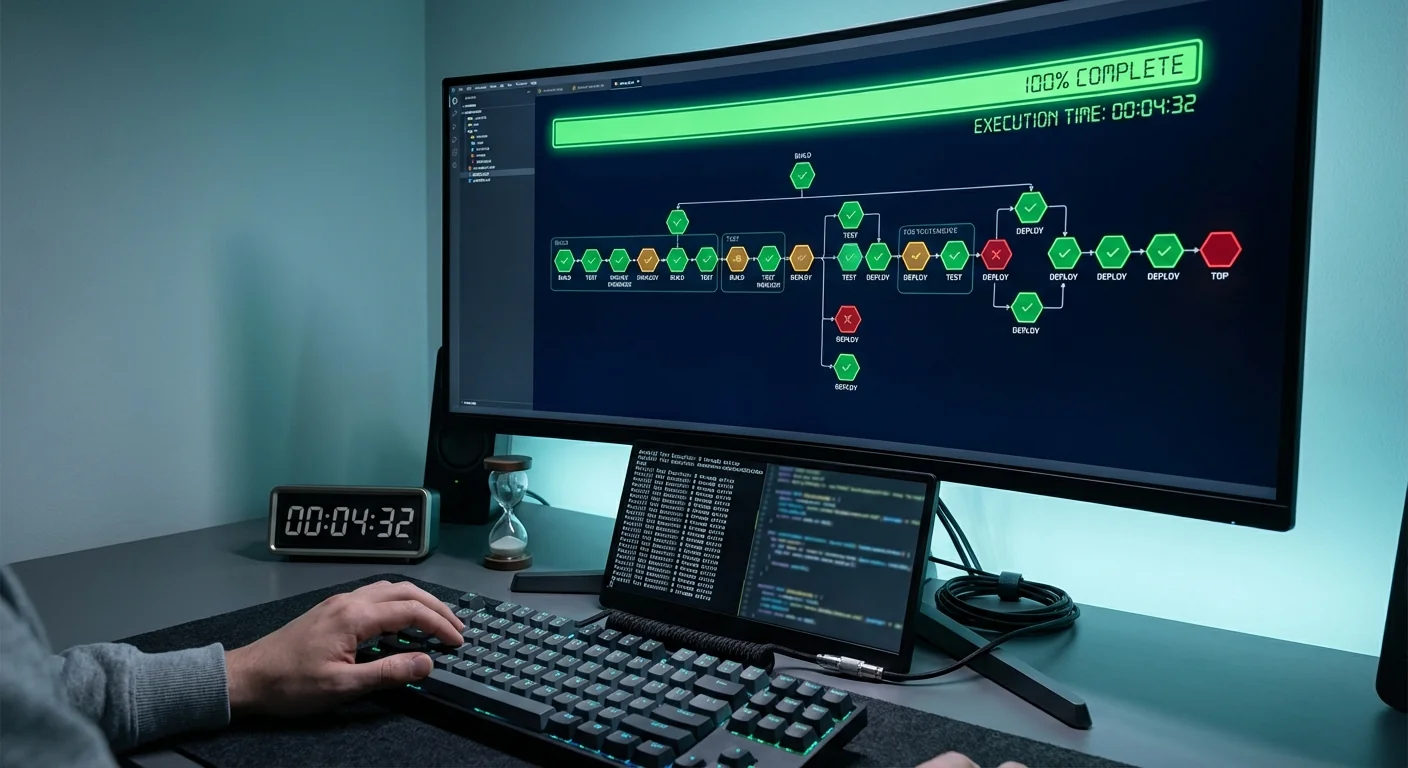
Most teams tell us "we already parallelize." When we look, they're running tests in parallel on a single machine, limited by CPU cores and memory. Real parallelization distributes across multiple machines.
What to do:
- Split your test suite into independent shards that can run on separate machines without shared state
- Use orchestration tools that distribute shards dynamically (Playwright's built-in sharding, or CI-level parallelization with GitHub Actions matrix/CircleCI parallelism)
- Ensure tests don't depend on execution order or shared data
The blocker most teams hit: Test isolation. Tests that share database state, use hardcoded ports, or depend on external services in a specific sequence can't parallelize safely. Fix isolation first, then parallelize.
Results: A suite that takes 45 minutes on one machine runs in 8-12 minutes on 4 machines. The cloud compute cost is minimal — the engineering time savings justify it after the first sprint.
3. Kill the flaky tests
Flaky tests are tests that sometimes pass and sometimes fail without any code change. They're the silent killer of regression testing trust. When 5-10% of your suite is flaky, the team stops trusting any failure and starts re-running until green. "Re-run until it passes" means your regression suite is no longer testing — it's performing.
The quarantine method:
1. Track flaky tests automatically (most CI platforms can detect tests that fail intermittently)
2. Move flaky tests to a quarantine suite that runs but doesn't block deployments
3. Assign one engineer per sprint to fix or delete quarantined tests
4. Rule: if a test has been quarantined for 3+ sprints, delete it and write a new one from scratch
The root causes: 90% of flaky tests come from four sources: timing dependencies (hardcoded waits instead of condition-based waits), shared mutable state between tests, external service dependencies without mocking, and browser animation timing in E2E tests.
Fix these four patterns and your flaky rate drops below 2%.
4. CI/CD integration with smart triggering
Regression shouldn't be a phase. It should be an automated pipeline stage that runs continuously.
Pipeline redesign:
| Trigger | What runs | Execution time | Blocks |
|---|
| Every PR | Risk-based subset from changed modules | Under 5 minutes | Merge |
| Merge to main | Expanded subset: changed modules + dependencies | Under 10 minutes | Deploy to staging |
| Deploy to staging | Full regression suite (parallelized) | Under 20 minutes | Deploy to production |
| Post-production deploy | Smoke tests (top 10 critical flows) | Under 2 minutes | Triggers rollback |
| Nightly | Full suite + performance + security | Under 1 hour | Creates tickets |
The shift: Regression moves from "3-5 days after development" to "20 minutes after merge, running in the background." The team doesn't wait for regression to finish. They receive a report.
5. AI-assisted test optimization
This is newer, but the results are measurable. AI tools can analyze your test execution history and identify:
- Tests that have never caught a bug (candidates for deletion)
- Tests that always pass together (one can be removed)
- Tests that frequently catch bugs (should run first for faster feedback)
- Code changes that historically cause specific test failures (predictive test selection)
Tools: Launchable, Testim with predictive features, and custom ML models that analyze test execution logs. The investment is 1-2 weeks of setup plus ongoing tuning.
Results: We deployed AI-assisted test selection on a SaaS client's regression suite. Predictive selection ran 30% of the suite per build and maintained a 97% regression detection rate. The 3% it missed were caught in the nightly full run. Average developer feedback time went from 42 minutes to 9 minutes.
Before and after: real numbers
From three Globalbit engagements where we restructured regression testing:
| Metric | Fintech client | E-commerce client | SaaS client |
|---|
| Tests before/after | 4,200 → 1,100 | 2,800 → 900 | 6,100 → 1,500 |
| Execution time | 72 hours → 28 min | 5 days → 22 min | 8 hours → 15 min |
| Defect detection | 62% → 78% | 58% → 74% | 67% → 81% |
| Flaky rate | 12% → 1.5% | 8% → 2% | 15% → 1% |
| Deploy frequency | Weekly → Daily | Bi-weekly → 3×/week | Weekly → Daily |
The pattern is consistent: fewer, better tests run faster and catch more. The bloated suite gives a false sense of security while slowing everything down.
FAQ
Won't risk-based selection miss bugs in unchanged code?
That's what the nightly full run is for. Risk-based selection is for PR-level feedback speed. The full suite is the safety net. In practice, we've seen risk-based selection miss less than 3% of regressions that the full suite catches, and those are caught within 24 hours.
How do we know which tests to delete?
Run test impact analysis: which tests have caught real bugs in the last 12 months? Tests that have never caught a bug are candidates for review. Don't delete blindly — review each candidate and determine if the test covers a genuine risk that hasn't materialized or if it's truly redundant.
Our testers don't know how to parallelize tests. Who does this?
This is typically a DevOps or platform engineering task, not a QA task. If you don't have that expertise in-house, it's a project that an external team can complete in 2-3 weeks. We've restructured regression suites across 200+ projects. Let's talk about yours.
What if our entire product is tightly coupled and we can't do risk-based selection?
Then tight coupling is your biggest quality problem, not regression testing speed. Start with parallelization (fix 2) and flaky test elimination (fix 3) to reduce execution time. In parallel, invest in decoupling — even partial modularization enables partial risk-based selection. Need help with both testing and architecture? That's what we do.