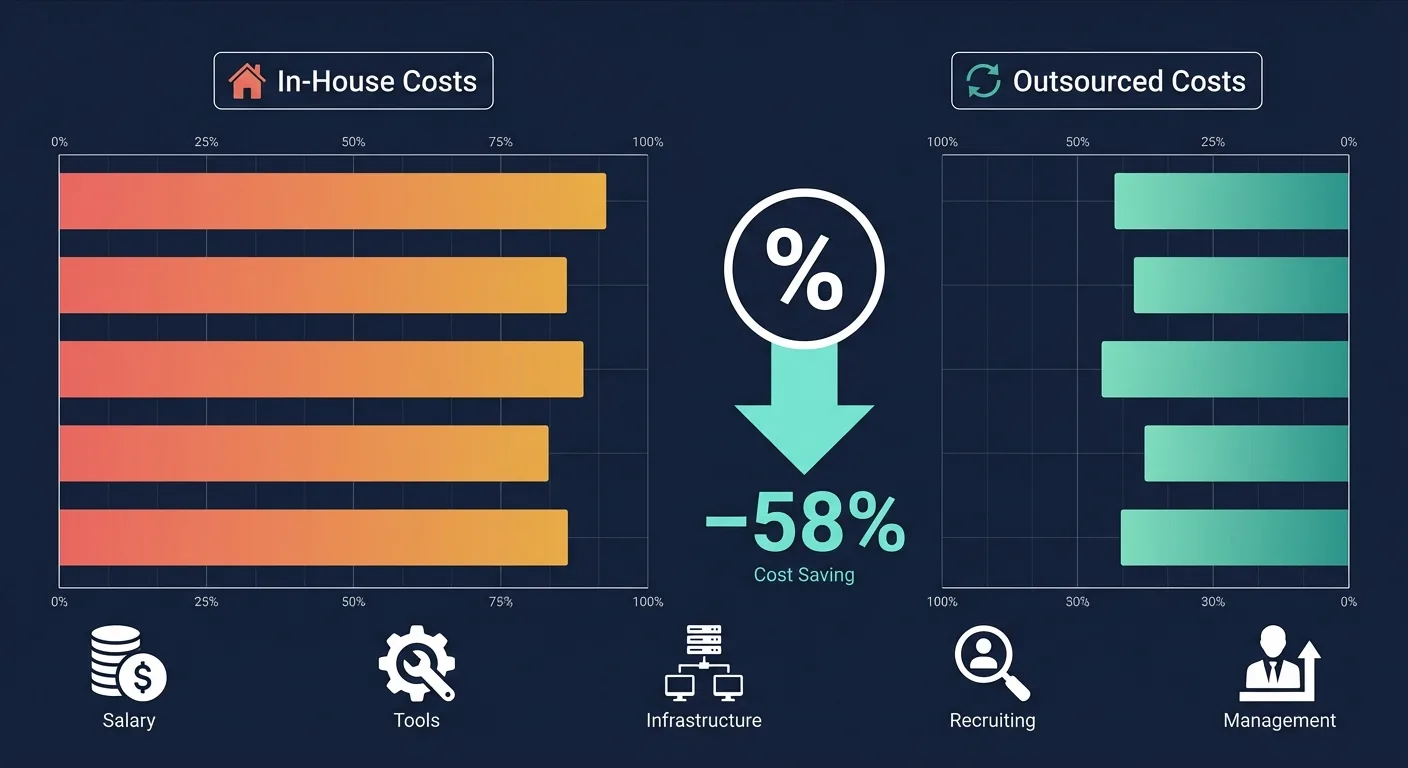
Hidden costs most CTOs miss
Recruiting time: Finding a good QA engineer takes 6-12 weeks in the Israeli market. During that time, you have no QA capability. Every bug that ships to production during this gap has a cost.
Management overhead: Someone has to manage the QA engineer — assign work, review output, handle 1:1s, set career development goals. This typically takes 4-6 hours per week of a team lead or engineering manager's time. At ₪150/hour (fully loaded engineering manager cost), that's ₪2,400-3,600/month.
Knowledge risk: If your one QA engineer leaves (and the average tenure in Israeli tech is 2-3 years), you lose all institutional testing knowledge. Recruiting starts over. The onboarding cost repeats.
Coverage gaps: One person can't cover everything. They take vacation (20+ days/year in Israel). They get sick. They focus on the features they're working on and other areas don't get tested. A single QA engineer provides inconsistent coverage.
Infrastructure costs: Test environments, cloud computing for CI/CD, device farms for mobile testing. These aren't free and they're often not budgeted when someone says "let's hire a QA engineer."
The realistic year-one cost
When you add management overhead, knowledge risk coverage, and infrastructure:
True year-one cost for one senior QA engineer: ₪500,000-750,000
Monthly equivalent: ₪42,000-62,500
The full cost of outsourced QA (year one)
Direct costs
| Cost item | Annual amount | Monthly equivalent | Notes |
|---|
| Service fee | ₪180,000-300,000 | ₪15,000-25,000 | Dedicated QA engineer equivalent |
| Setup and onboarding | ₪5,000-10,000 | Amortized | Week 1-2 of engagement |
| Tool licenses | ₪0-12,000 | ₪0-1,000 | Often included; you may need some internal tools |
Year one total for outsourced QA: ₪185,000-322,000
Monthly equivalent: ₪15,400-26,800
What's included that you'd pay separately in-house
- Team coverage: If your assigned engineer is on vacation, the vendor provides backup. You're never without QA.
- Tool stack: Most vendors include BrowserStack, test management tools, and CI/CD integration in their pricing.
- Device farm access: Real mobile devices for testing, maintained by the vendor.
- Management and training: The vendor manages QA engineers, handles career development, and keeps skills current.
- Process knowledge: The vendor brings established testing processes from dozens of previous engagements. You don't reinvent the wheel.
- Scaling flexibility: Need more coverage before a launch? Scale up for a month. Need less during a quiet period? Scale down. Try doing that with an employee.
The comparison
Year one
| In-house | Outsourced | Difference |
|---|
| Total cost | ₪500,000-750,000 | ₪185,000-322,000 | Outsourced is 43-57% cheaper |
| Time to first test | 8-14 weeks (recruiting + onboarding) | 2-3 weeks | Outsourced is 4-6× faster |
| Coverage during ramp | None for 2-3 months | Partial from week 1 | Outsourced has no gap |
| Scalability | Fixed (1 person) | Flexible | Outsourced adapts to needs |
| Knowledge risk | Single point of failure | Team-backed | Outsourced is more resilient |
Year two
The gap narrows because in-house recruiting and onboarding costs don't repeat:
| In-house | Outsourced |
|---|
| Total cost | ₪380,000-520,000 | ₪180,000-300,000 |
| Product knowledge | Deep | Solid (12 months of context) |
| Team integration | Fully embedded | Integrated but external |
Year three
If you retain the QA engineer (which is not guaranteed — Israeli tech has high turnover):
| In-house | Outsourced |
|---|
| Total cost | ₪370,000-500,000 | ₪180,000-300,000 |
| Product knowledge | Expert-level | Expert-level |
| Independence | Fully self-sufficient | Dependent on vendor |
In-house becomes more cost-effective per hour in year three, but outsourced remains cheaper in absolute terms because the vendor's efficiency and scale advantage persists.
When to go in-house
Despite the cost advantage of outsourcing, in-house QA is the better choice when:
Your product requires deep domain expertise that takes years to develop. If you're building medical devices, financial trading systems, or defense technology, the QA engineer needs domain knowledge that outsourced rotations can't match.
You're building a QA engineering function, not just testing. If your goal is QA engineers who also build internal testing tools, contribute to test infrastructure, and act as quality coaches for developers — that level of integration works better in-house.
Retention is realistic in your market. If you're in a location with lower tech turnover and can retain QA engineers for 4-5+ years, the long-term cost advantage of in-house compounds.
You have multiple products that share testing infrastructure. An in-house team can build shared testing frameworks across products more efficiently than managing multiple outsourced engagements.
When to outsource
You need QA capability within weeks, not months. Outsourced QA produces results in 2-3 weeks. Hiring takes 2-3 months minimum.
You're unsure what kind of QA you need. Outsourcing is a lower-risk way to establish QA processes. You learn what works before investing in permanent headcount.
Your testing needs fluctuate. Pre-launch sprints, seasonal peaks, or project-based work? Outsourced QA scales up and down. Employees don't.
You want established best practices. A QA vendor brings processes refined across dozens of engagements. In-house, you build from scratch unless you hire someone with that experience (and they cost more).
The hybrid model
Most of our long-term Globalbit clients end up here:
Internal team (1-2 engineers): Own daily regression, sprint integration, and deep product knowledge. They're embedded in the development team and participate in design reviews.
Outsourced partner: Handles specialized testing (security, performance, mobile device coverage), provides surge capacity before releases, and brings AI testing capabilities that aren't worth building in-house for a single product.
This model costs roughly ₪45,000-70,000/month total and provides broader coverage than either approach alone.
FAQ
How do I compare proposals from different QA vendors?
Ask each vendor to break down their pricing into: dedicated engineering hours, tool costs, management overhead, and what's included vs. extra. Compare on a per-hour basis AND on a deliverable basis. The cheapest hourly rate doesn't always mean the lowest cost if one vendor is more efficient.
What if we hire in-house and it doesn't work out?
In Israel, termination costs add ₪30,000-50,000 in severance, notice period, and recruiting costs to replace. This risk is zero with outsourced QA — you adjust or end the engagement with standard notice.
Can we start outsourced and move in-house later?
This is actually the recommended path. The outsourced engagement establishes the testing process, builds the initial automation suite, and creates documentation. When you hire internally, the new engineer inherits a working system instead of building from scratch. Globalbit designs engagements for this transition — let's discuss your timeline.
Is outsourced QA as good as in-house?
For the first 12-18 months, outsourced QA is typically better because the vendor's engineers have more testing experience across more products. After 18 months, a retained in-house engineer with deep product knowledge can match or exceed outsourced quality for product-specific testing. The ideal answer is usually "both" — which is why the hybrid model exists. Let's figure out the right model for your team.