
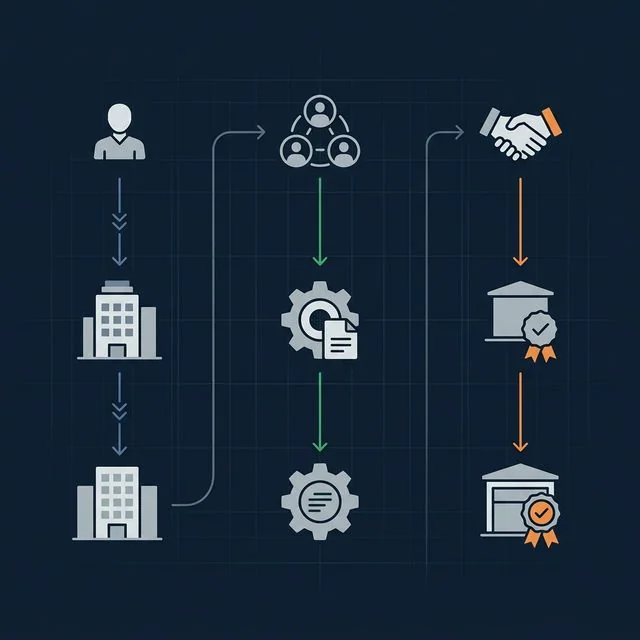
TL;DR: Staff augmentation gives you control but demands management. Dedicated teams give you continuity but require commitment. Project-based outsourcing gives you predictability but sacrifices flexibility. The right model depends on how stable your requirements are, how strong your internal technical leadership is, and how long you need the relationship to last.
The three models, without the marketing spin
Every outsourcing provider claims their model is "the best." In practice, each model makes a specific trade-off between four factors: control (how much you direct the work), cost (total expenditure including your management time), context (how deeply the team understands your business), and continuity (how stable the team composition is over time).
Here's how each model actually works, with honest trade-offs.
Staff augmentation: renting expertise
How it works: You hire individual developers (or small groups) through a staffing provider. They join your existing team, use your tools, follow your processes, and report to your managers. The agency handles payroll, benefits, and HR. You handle everything else.
Best for: - Filling specific skill gaps (need a React Native developer for 4 months? This is how) - Scaling a team that already has strong internal leadership - Short-term capacity needs with defined end dates - When you want full control over technical decisions and daily priorities
Realistic costs: $35-$85/hour for developers sourced from Eastern Europe, Latin America, or Southeast Asia. $80-$150/hour for US-based or Western European talent. Add 15-25% for agency overhead and management fees.
The trade-off most buyers miss: management cost.
When you augment with 3-4 external developers, your internal team lead or engineering manager spends 30-40% of their time on integration, onboarding, code review, and communication overhead. That management cost never appears on the agency's invoice, but it's real. For a VP of Engineering earning $200K/year, 35% of their time dedicated to managing augmented staff costs roughly $70K in management overhead — on top of the developer fees.
When it breaks down: - When your internal team doesn't have bandwidth to manage the augmented staff - When you need the team for longer than 12 months (at that point, a dedicated team is more cost-effective) - When the work requires deep business context that takes months to build
Dedicated team: extending your organization
How it works: You partner with an agency that assembles a team specifically for your project. The team works exclusively on your product — no shared attention with other clients. They have their own project manager, follow your methodology (or adapt it for distributed work), and build institutional knowledge over time.
Best for: - Ongoing product development without a defined end date - Complex products that require deep domain understanding - Companies that want agency management infrastructure without building it internally - Organizations that need to scale from 3 to 15 people as the product grows
Realistic costs: Monthly retainers typically range from $15K-$50K per month for a 3-5 person team (depending on seniority and location). Annual cost for a 5-person team: $180K-$600K. Compare that to fully-loaded costs for 5 internal engineers in the US: $750K-$1.2M annually.
The trade-off most buyers miss: ramp-up time.
A dedicated team doesn't hit full productivity on day one. Expect 4-8 weeks of onboarding: learning your codebase, understanding your business logic, integrating with your workflows. During ramp-up, you're paying full rates for 40-60% productivity. For a $40K/month team, that's $20K-$32K in ramp-up costs before the team is fully effective. Worth it for a 12+ month engagement. Expensive for a 4-month project.
When it breaks down: - For short projects (under 6 months, the ramp-up cost makes it uneconomical) - When requirements change so dramatically that the team composition needs to change too - When the company can't dedicate an internal Product Owner or technical liaison
Why a complete team outperforms a group of contractors. Hiring five individual contractors gives you five people who have never worked together. Your internal team then spends real time coordinating them. A dedicated team arrives as a unit, and that shows in three ways:
- It skips the forming stage. Individually hired contractors need weeks to settle how they split work, review code and resolve disagreements. An established team has already done that.
- It brings a working process. Standups, ticket breakdown, code review and blocker handling are already in place. You align their process with yours, which is faster than building one.
- Quality control is built in. The senior developer reviews the junior's code before it reaches you. The QA engineer knows the typical failure patterns, and the tech lead catches architecture issues early.
From our work. Egged shows the dedicated model over time. It started as a 3-month rescue that took Egged's app from 2.2 to 4.7 stars. It grew into a 5-year partnership in which we served as Egged's mobile team: the consumer app, the TikTak on-demand transit service we built from scratch, and internal operations tools. IBI Smart shows the build-then-transfer path. We built the product with a full team, ran it for two years, then moved the team, processes and knowledge to IBI.