
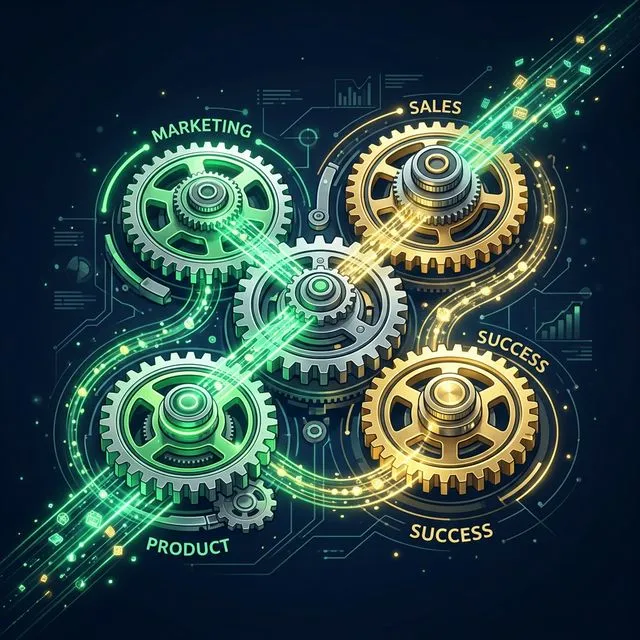
TL;DR: A revenue engine is the integrated system of technology, data, and processes that drives repeatable revenue growth. It connects marketing, sales, product, and customer success so money flows through your business in a measurable, improvable pipeline. Most companies have the individual pieces — CRM, analytics, marketing automation — but they operate as disconnected silos. The difference between a stack and an engine is integration.
Everyone has tools. Almost nobody has a system.
Open your company's SaaS directory. Count the subscriptions. CRM, marketing automation, analytics, billing, customer support, product analytics, email platform, ad management, data warehouse. BetterCloud's SaaS research projects an average of 118 SaaS apps per company in 2026, up from 106 in 2025.
Now ask yourself: can you trace a single customer from their first website visit through their first purchase and into their fifth year of renewals, all in one place?
If the answer is no — and for most companies it is — you have a tech stack, not a revenue engine. The distinction matters because a stack is a collection of tools. An engine is a system that produces measurable output.
What a revenue engine actually does
A revenue engine connects four stages of customer interaction into one measurable flow:
Stage 1: Attract
How potential customers find you. Content, paid ads, SEO, events, partnerships. The important part isn't which channels — it's whether you can measure which produce customers, not just clicks.
Most companies can tell you which campaign got the most clicks. Very few can tell you which campaign produced the most revenue 12 months later.
Stage 2: Convert
A visitor becomes a lead. A lead becomes an opportunity. An opportunity becomes a deal. Each transition has a conversion rate that can be measured and improved.
This is where your CRM, website, and sales process need to work as a single flow. If marketing generates leads that dump into a CRM where sales reps manually research each one, you've built friction where speed matters most.