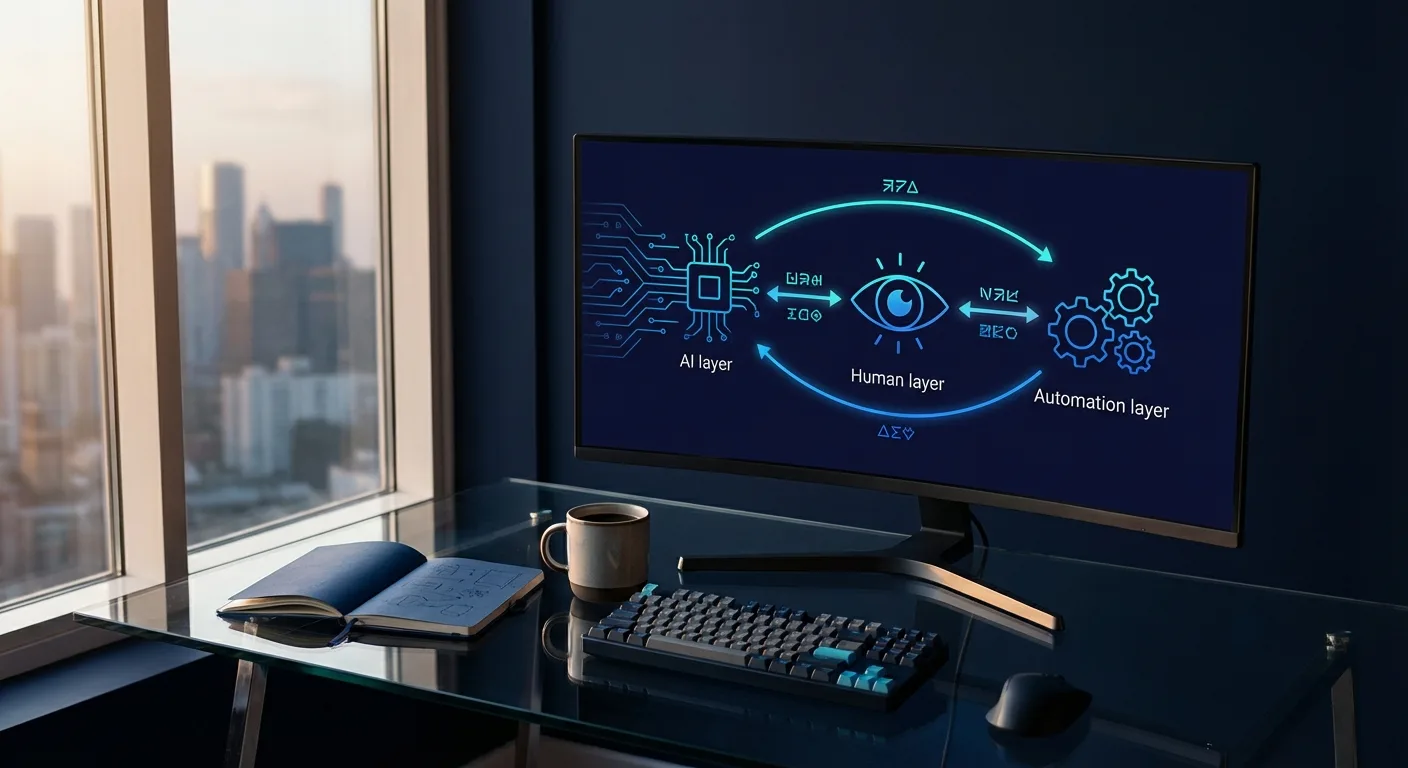
Layer 2: Human-owned quality strategy (judgment, context, creativity)
Humans own what AI can't do:
Test strategy design: Deciding what to test, how deeply, and where to invest coverage. This requires understanding business risk, customer behavior, and competitive context. AI can tell you what code changed. It can't tell you which changes matter most to your revenue.
Exploratory testing: The creative, adversarial mindset that tries the weird path, the unlikely input, the user behavior that no spec anticipated. This is where QA engineers find the bugs that matter most — the ones that automated tests never thought to check.
Security review with business context: AI catches OWASP-style vulnerabilities. Humans catch the authorization logic that allows a customer to see another customer's data. Pattern-matching security vs. contextual security.
Accessibility and UX quality: Testing with screen readers, keyboard navigation, and the perspective of users who interact with your product differently than your developers do.
Quality metrics and reporting: Interpreting what the data means, identifying trends, and recommending strategic changes to the QA approach.
Expected coverage contribution: 30-40% of total test execution volume, but these tests cover 70-80% of critical risk areas.
Layer 3: CI/CD enforcement (automated gates, zero trust)
The pipeline enforces quality without human intervention:
| Gate | What runs | Who owns it | SLA |
|---|
| Pre-commit | Linting, type checks, AI security scan | Platform team | Under 10 seconds |
| PR check | AI-generated regression tests + unit tests | AI + developers | Under 5 minutes |
| Pre-deploy | Full AI test suite + human-written critical path tests | AI + QA team | Under 15 minutes |
| Post-deploy | Smoke tests + AI visual regression | AI | Under 2 minutes |
| Nightly | Comprehensive suite + performance + security scans | AI + QA team | Under 1 hour |
The key principle: No code reaches production without passing automated gates. Humans don't manually approve deploys. The system does. Humans intervene when gates fail.
Where AI testing agents fail
We cover this in more depth, with examples from our own deployments, in what autonomous QA agents actually do.
The boundary between Layer 1 and Layer 2 matters because agents fail in predictable places. Those places are usually where your risk is highest.
Business rules. An agent can confirm that a discount field changes the total. It can't confirm that the discount follows your stacking rules, expiry conditions, eligibility and territory limits. On one fintech loan-origination flow, an agent generated a large suite of tests and every one passed. The flow still accepted applications above the regulatory maximum for some customer segments. The agent didn't know the regulation existed.
Security that depends on context. Agents run pattern-based checks for XSS, SQL injection and CSRF well. They don't know that your healthcare app stores PHI, that tenants must never see each other's data, or that one endpoint is reserved for a single role. The costly security bugs sit in business logic that opens authorization gaps.
Edge cases that need a human view. A screen-reader user at checkout. A connection that drops mid-payment. A name typed in a script the developer never expected. A good QA engineer tries the strange path on purpose. An agent follows the expected one.
Flows that span several systems. An agent can test each integration point alone. It struggles with the full sequence: a payment fails, the CRM updates, the user gets a notification and the analytics event fires, all in the right order.
The 90-day implementation path
Month 1: Foundation (weeks 1-4)
Week 1-2: Assessment and tooling
- Audit current test coverage and identify the 20% of code that causes 80% of production bugs
- Select AI testing tools based on your stack (we evaluate tools per engagement because the landscape changes quarterly)
- Define the human-AI boundary: list every testing activity and classify as AI-owned, human-owned, or shared
Week 3-4: First AI layer deployment
- Deploy AI visual regression testing across all pages
- Set up AI-generated API contract tests for your top 10 endpoints
- Configure CI/CD gates with appropriate SLAs
Milestone: AI is running tests on every deploy. Humans are still doing everything else, but they can see what AI catches.
Month 2: Integration (weeks 5-8)
Week 5-6: AI test generation pipeline
- Connect AI test generation to your code diff pipeline
- Establish feedback loops: when AI-generated tests produce false positives, humans correct them, and the system learns
- Start measuring: AI detection rate vs human detection rate by bug category
Week 7-8: Team restructuring
- Shift QA engineers from test execution to test strategy and exploratory testing
- Train the team on AI tool management and prompt engineering for test generation
- Establish the Quality Guild: weekly meeting where humans review AI testing effectiveness and adjust strategy
Milestone: AI handles 40-50% of test execution. Humans focus on the testing that requires judgment. Defect escape rate is measurably lower.
Month 3: Optimization (weeks 9-12)
Week 9-10: Advanced AI capabilities
- Deploy AI-assisted test selection (predictive test running based on code change patterns)
- Implement AI-powered test impact analysis
- Add AI monitoring for production error patterns that should become test cases
Week 11-12: Measurement and iteration
- Measure ROI: testing cost, defect escape rate, time to detect, deploy frequency
- Identify remaining gaps in AI coverage and invest human effort there
- Document the strategy for new team member onboarding
Milestone: Mature AI-first QA operating at target metrics. ROI quantified and reportable.
The team structure shift
| Traditional QA team | AI-first QA team |
|---|
| 5 QA engineers doing manual + automated testing | 2-3 senior QA engineers + AI tooling |
| 60% time spent on test execution | 20% time on execution, 80% on strategy |
| Bottleneck before every release | Continuous quality integrated into CI/CD |
| Defect escape rate: 25-40% | Defect escape rate: 8-15% |
| Testing as a phase after development | Testing as an automated pipeline stage |
The team doesn't shrink as much as it transforms. You need fewer people doing repetitive work and more people doing strategic work. The cost reduction comes from efficiency, not layoffs — though you can scale testing capacity without proportional headcount increase.
What this costs
Tools: $1,000-3,000/month for AI testing platforms depending on scale
Implementation: 2-3 months of focused effort from a QA or platform engineer
External help (optional): An experienced partner can compress the 90-day path to 60 days because they've done it before
What it saves:
- 60% reduction in test creation time
- 40-52% reduction in overall QA costs over 3 years
- 70%+ reduction in defect escape rate
- 2-3× improvement in deploy frequency
These numbers are from Globalbit's aggregated experience across projects where we've implemented this architecture. Individual results depend on starting maturity and product complexity. Measure your baseline on these four metrics before you start, so you can report the change.
Common objections from CTOs
"We're not ready for AI-first QA — we barely have testing now"
Then you're actually in the best position to do this. You don't have legacy test suites to migrate, entrenched processes to change, or team resistance from people who've done it the old way for years. Start with the blueprint and build it right from day one.
"My QA team will resist this"
Frame it correctly: AI handles the work they hate (repetitive regression testing, test maintenance, screenshot comparison). They get to focus on the work that's interesting (exploratory testing, strategy, quality analysis). Every QA engineer we've worked with prefers the AI-first model once they experience it.
"How do I justify the investment to the board?"
The cost-of-bugs argument is quantifiable. Track your current production incident costs for one month. Multiply by 12. Then show the projected reduction with AI-first QA. The ROI is typically 3-5× within the first year, and a clear baseline turns that into a return the board can check. Here's how to build the business case, and we help CTOs put it together for AI-first QA.
FAQ
Can we do this incrementally or does it require a big-bang transition?
Incrementally. Start with Layer 1 (AI test generation for visual and API) while keeping your current human process intact. Gradually shift human effort from execution to strategy as AI coverage increases. The 90-day plan above is designed as an incremental rollout.
Can we buy an AI testing tool and skip hiring QA engineers?
No. Someone has to configure the tool, interpret its results and cover the areas it can't handle. A team with only AI agents ships bugs in business logic, security and accessibility.
What's the biggest mistake when deploying AI testing agents?
Deploying them before deciding what stays human-owned. The agent generates hundreds of tests, the team assumes coverage is excellent, and critical business-logic bugs reach production. Draw the human-AI boundary first.
Which AI testing tools should we use?
The landscape changes rapidly. As of early 2026, we evaluate tools per engagement based on tech stack, team size, and maturity. What works for a React SaaS product differs from what works for a mobile-first fintech. Talk to us about your specific situation.
What if our product is highly regulated (fintech, healthtech)?
AI-first QA actually helps with compliance because AI generates more comprehensive test documentation, maintains full audit trails, and catches regression issues that manual processes miss. Human-owned security and compliance testing becomes more focused because the volume work is handled. We've deployed this in regulated environments successfully.
How do you measure whether AI-first QA is working?
Four metrics: defect escape rate (should drop 50%+), test creation time (should drop 60%+), deploy frequency (should increase 2-3×), and QA cost per release (should drop 30-50%). If these numbers aren't moving after 90 days, the architecture needs adjustment. We provide this measurement framework as part of every engagement.